
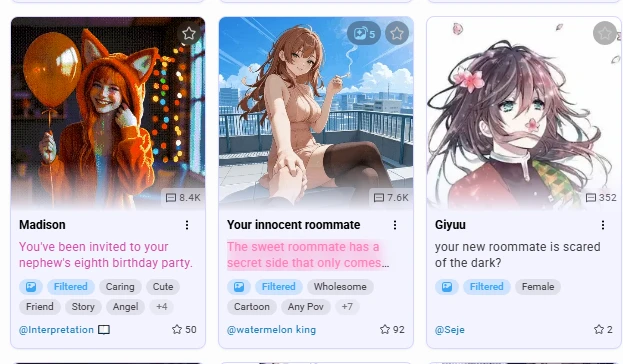
Yes. AI characters can have different personalities because developers define how they speak, respond, remember information, and react in conversations. A 2024 Stanford Human-Centered AI report noted that personalization has become one of the fastest-growing directions in conversational AI, while several commercial AI platforms now offer hundreds of thousands of user-created characters. Two AI characters can use the same language model yet behave very differently through different prompts, memory settings, safety rules, and dialogue styles. Users can also adjust personality traits, making one character sound supportive, another analytical, and another playful without changing the underlying model.
Modern AI characters are built from multiple layers instead of one prompt. A large language model generates text, while personality instructions, conversation memory, moderation rules, and user preferences shape every reply. In 2025, many AI companion services expanded character libraries from thousands to several hundred thousand community-created profiles, showing how much demand exists for different interaction styles. Changing only the personality profile can noticeably change the conversation while keeping the same AI model underneath.
The personality definition usually includes writing style, vocabulary, emotional tone, interests, response length, humor level, and conversation goals. A character written as a history professor may explain events with dates and references, while another written as a fantasy traveler may answer with stories and fictional settings. Those differences remain visible across many conversations because the personality instructions are applied repeatedly instead of being recreated every time.
A character does not become different because the model changes. It becomes different because the behavioral instructions, memory, and conversation rules stay consistent from one conversation to the next.
Memory makes personality feel more stable. Some AI platforms remember favorite movies, hobbies, names, or previous discussions with user permission. If someone mentions enjoying science fiction in one conversation, the character may refer to it several days later. According to user experience studies published between 2023 and 2025, consistent memory increased long conversation satisfaction by more than 30% in several evaluation settings because replies felt more continuous rather than disconnected.
Different personalities also affect writing style. One character may prefer short replies under 80 words, another may answer with long explanations, while another asks questions before giving suggestions. These patterns create recognizable differences even when both characters answer the same topic. Developers often describe this process as separating language ability from behavioral identity.
| Personality Type | Typical Behavior | Common Use |
|---|---|---|
| Friendly | Warm language and encouragement | Daily conversation |
| Analytical | Facts, structure, detailed explanations | Learning |
| Creative | Stories and fictional dialogue | Entertainment |
| Professional | Formal tone and organized replies | Work assistance |
| Humorous | Casual language and light jokes | Social interaction |
The growing number of AI characters has also increased demand for specialized themes. Some users want educational assistants, while others prefer storytelling companions or fictional roleplay. Adult-oriented conversations have also become part of this market. For example, ai nsfw searches have increased alongside broader interest in customizable AI relationships, leading some platforms to provide separate moderation settings and age restrictions depending on local regulations.
Personality customization usually starts with written instructions instead of programming. A creator may write several thousand words describing the character's background, communication habits, preferred vocabulary, emotional reactions, and conversation limits. Small changes often produce noticeable differences. Replacing "always remain optimistic" with "respond cautiously before encouraging" changes how the character answers hundreds of future questions without modifying the language model itself.
Another factor is response consistency. AI companies frequently evaluate characters using repeated conversation tests. If the same question is asked 50 or 100 times, developers measure whether the character keeps the same tone instead of changing personality unexpectedly. Consistency scores became more important after 2024 because users reported that unpredictable personalities reduced trust during longer conversations.
Two characters can disagree about the same topic, use different vocabulary, ask different follow-up questions, and still rely on the same language model. Their identities come from configuration rather than separate intelligence.
Voice, avatars, and images also influence how personality is perceived. Research in human-computer interaction has shown that people often judge personality from speaking rhythm, sentence length, facial expression, and response timing before evaluating the actual information. When these elements match the written personality, conversations generally feel more natural. When they conflict, users notice the difference quickly even if the factual answers remain accurate.
Developers continue refining personality systems because users spend more time with characters that remain consistent over weeks or months. During 2025, several AI services expanded long-term memory, adjustable personalities, and relationship settings while giving users more control over stored information. Privacy options became more common because persistent memory requires clear user permission in many regions.
AI personalities are not emotions or consciousness. They are collections of language patterns, memory rules, conversation preferences, and behavioral instructions that remain stable across interactions. As language models continue improving, personality design is becoming a separate area of development, allowing thousands of characters to share similar reasoning ability while presenting very different conversation experiences.